GEOGRAPHY
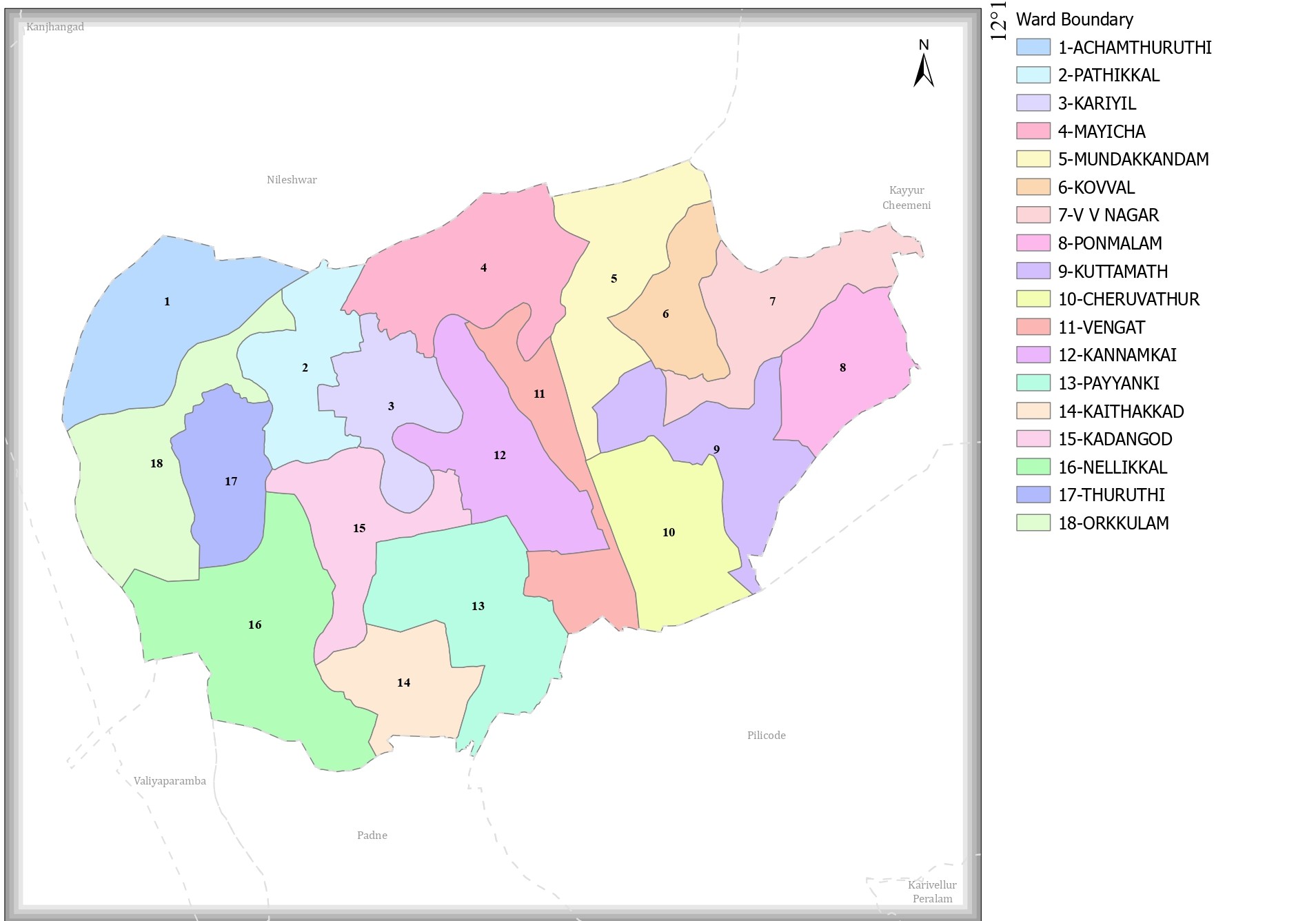
Cheruvathur is a Grama Panchayat in the Nileshwar Block of Hosdurg Taluk in Kasaragod district. The Panchayat includes Cheruvathur Village and covers an area of 18.37 square kilometers. Its boundaries are: Nileshwar Panchayat to the north, Kayyur-Cheemeni and Pilicode Panchayats to the east, the Arabian Sea to the west, and Pilicode and Padanna Panchayats to the south.
For administrative convenience, the British included South Canara district under the Madras Presidency on May 16, 1862. Consequently, this region, including Cheruvathur, became part of the Madras State. The Panchayat area originally consisted of two revenue villages, Cheruvathur I and Cheruvathur II, each having its own traditional Patel (village head). After the formation of the state of Kerala, village reorganization was carried out in 1962, and these two revenue villages were merged under a single Village Officer.
The first elected Panchayat in Cheruvathur was established in 1936, and its first President was U.P. Moytheen Haji Sahib.
The place name “Cheruvathur” is believed to have historical links with military settlements and ancient cultural traditions. In Kannada, the word “Chervvam” means “army,” and it is believed that “Chervvam + Oor” gradually evolved into “Cheruvathur.” Another view suggests that the name originated from “Sree Buddhoor” and later transformed into Cheruvathur.
Historically, the eastern region was inhabited by military leaders while Brahmins prospered in the western region. This cultural background helped the people of Cheruvathur develop both physically and intellectually. The land is also renowned as the birthplace of great literary figures such as Mahakavi Kuttamath and Malabar V. Raman Nair.
The cultural heritage of Cheruvathur is enriched by personalities such as C. U. K. Nambiar in music, drama, and cinema, and famous Kathakali artists like Ambu Panikkar and K. K. Ukkaran Nambiar. The traditional folk art form “Poorakkali,” one of the finest ritual arts of North Kerala, is still performed here during temple festivals.
Cheruvathur was also known for its traditional physicians, including the Vaidyapadans of Kunniyoor Tharavadu, experts in mental health treatment at Kaari, bone-setting specialists, and Siddha practitioners. Kathakali maestro Ambu Panikkar was highly praised by Vallathol Narayana Menon.
The Panchayat is home to several temples that serve as important cultural centers. Mosques and Juma Masjids of the Muslim community stand harmoniously alongside temples in many parts of the Panchayat, reflecting the region’s communal harmony.
Geography of Cheruvathur
Cheruvathur is an important region in the northern part of Kasaragod district in Kerala. Situated between the Arabian Sea and the Western Ghats, the area features coastal plains, small hills, and river basins.
Main Geographical Features
- Location: Southern part of Kasaragod district.
- Coordinates: Approximately 12.14° N latitude and 75.17° E longitude.
- Topography: A combination of coastal plains, backwaters, and small hills.
- Water Resources: Nearby rivers and backwaters support agriculture.
- Climate: Tropical monsoon climate with heavy rainfall from June to September.
- Soil Type: Predominantly red laterite soil and alluvial soil.
- Vegetation: Coconut, cashew, and paddy cultivation are common.
Transportation and Connectivity
- National highways and railway lines pass through the region, making it an important transport hub in North Kerala.
- It has good connectivity with nearby towns such as Kanhangad and Kasaragod.
Economic Activities
- Agriculture, fishing, and small-scale trade are the major occupations.
- Due to its coastal nature, fishing and coconut-based industries are well developed.